There are three things I want to get out of the way right up front:
1. Balder’s Gate 3 came out during my first play through of Diablo IV.
2. I was excited for Diablo IV. It had been well reviewed and I really enjoyed Diablo III.
These are the two wolves which competed within me during the entire time I played the campaign.
(This review will get into spoilers in the last section, The Story. Feel free to skip over that portion to get to the Final Score.)
The Gameplay
Diablo IV is a hack and slash kind of game, just like it’s predecessors. Your job, regardless of the story, is to wander around from quest giver to quest giver and slay hoards of beasts, monsters, and demons.
And in Diablo III, this felt fun. Even at low levels you felt fairly powerful and by the time you came to the end of the game, you felt god-like.
By the end of Diablo IV, I was ready for the game to be over. Some of this involved the other problems I had with the game, but a lot of it had to do with the fact that I leveled up and didn’t necessarily feel a lot more powerful. By the time I reached the end of my skill tree (as a druid) and my wife reached the end of her skill tree (as a rogue), we both felt entirely underwhelmed by whatever power boost we apparently had. Ultimately, the main reason we finished the game was that it was a game we could play together on the couch (a rarity these days).
One of the things Diablo IV does right is the skill tree. It was really cool to see how I’m not just a druid, but that I have several options to pull my abilities from. I ended up mixing up all four: I used the lighting basic strike (because it made it feel like my weapon actually mattered), the bear area attack, the werewolf buff, the boulder earth attack, the crows distance area attack, and the storm final ability. I built myself for crowd control and my wife built her character to take down strong individual targets. We felt really free to mix up these abilities— and was glad that I could pay a little (of in-game currency) to reset my tree and spend all my points however I wanted. Sadly, the builds didn’t hold out like we’d hoped and like they did within the first few days of release.
Online Service Drags the Game Down
The thing that drags down this game more than anything is that it goes from being a self-contained game to being an online service. In order to boot it up, you have to sign in or create an account with Blizzard. When the servers are down, or if you don’t have internet, you can’t play the game you just shelled out for. This made for some pretty annoying points where we were kicked off and had to replay certain parts of the game.
While this can be annoying, the real frustration was when I noticed the subtle changes after updates. My character would be less powerful or my gear wouldn’t do as much damage or when good gear drops became almost zero. When we first started playing we were wiping the floor with the monsters to the point we were almost bored; we got loot that was so powerful that we felt like it was crazy. Then the changes made it so that we never really got great loot and that we had to really slog through the enemies, which was a worse kind of boredom.
I think one of the only things I can say on a positive note from this connectivity is that the game is hoping you shell out extra real money on skins for your character instead of trying to do some kind of loot-box system for pay-to-win.
Cutscenes? What Cutscenes?
Another source of boredom comes from the lack of cutscenes. There are a few throughout the game, which almost serve as a reminder that they had the capability of doing some great cutscene work and chose not to. Most of the time you have a vague view of a conversation from a distance and often your only interaction is to ask for more info (if you’re interested) or click the next quest marker conversation option. I don’t want this to sound like I didn’t enjoy this just because I started to play Balder’s Gate 3 about halfway through our play through. It feels archaic when you have a story I can’t really make choices to affect and don’t have cutscenes for what feel like pretty major story moments. And then to interrupt these story moments to have the player walk from one character in the conversation to another character also in the conversation to receive the next quest or just move the conversation along. I don’t know that I’ve played another game in years that hadn’t figured out how to mark a quest as complete and give a new one within one cutscene conversation; I don’t understand how the developers didn’t figure this out themselves.
The Story (Spoilers)
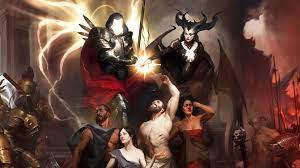
The story of Diablo IV starts off great, shifts down a little to interesting, shifts way down to annoying slog, and then ends on a meh.
You begin as a visitor to a village, escaping a blizzard. Through an opening couple of scenes (some of the best in the game), you ingest a blood petal connected to Lilith, humanity’s demon mom, which allows you to see moments where she was particularly interesting in a place.
You then follow demon mom around as she tries to get her groove back after the patriarchy got her down, seeing places where she did something of note, trying to figure out what she’s doing, and then go stop her.
At the beginning, this is a blast. (It was the early hours of the game having launched and we still felt powerful.) You then move into some pretty heavy lore exposition as Lilith releases demons and goes to visit her son and is trying to get into hell so she can take down her dad. It’s good. Not worth the 9/10 IGN gave it, but good.
But then you reach act V. The moment you’ve been waiting for the whole game. And you find out… that the developers didn’t know how to pace their story. Instead of Act V being the rush into hell alongside the army of the faithful to stop Lilith once and for all, you have two EXTREMELY long side-quest-story-quests to do. Both of which feel like you should have done them earlier. In act IV, for example. Or like they should have been cut altogether. Especially because the game makes it clear that what you’re doing in one of these quests is important; they’re the only way to stop Lilith. And after that you get to REAL ACT V and get to do what you knew was the plan all along: ignore that plan entirely as you smash demons to fight demon mom and stop her wiping the world clean and starting over— which, from all the demons and death in the story, you feel like you can see where the cultists are coming from. But the fact that you spend hours in Act V working toward a plan that the game tells you is the only way to defeat Lilith and then defeat her without that plan is infuriating.
Final Score
Even trying to judge this game on its own merits and the kind of game it is makes Diablo IV feel lacking. While there are games out there that give you almost endless choice to change story elements and affect the ending, this isn’t one of those games. You spend the game in an open world that might as well be on a track to get you from story beat to story best as the developers change the game to make you less powerful and have fewer rare gear drops. This all ultimately leads to a “climactic” ending of taking down your mentors old buddy-turned-traitor (two acts too late), and getting a soul crystal trap ready (three acts too late), before finally going on to the actual climactic ending— but ignoring the work you did to get there for the brute force you knew you were going to use all along.
This game might still be worth getting for some die-hard Diablo fans or fans of this kind of game, but even then I would say you should wait for it to go on sale.
 Storyscribe